What you will study
Lesson 1
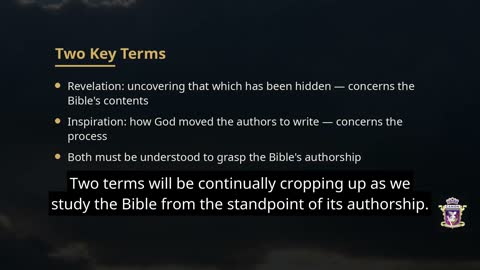
This opening lesson frames the course's central question of who authored the Bible by contrasting the first-century Gnostic and Docetist attacks on Christ's incarnation with modern denials of Scripture's supernatural character. It surveys competing views of authorship, introduces the twin ideas of revelation and inspiration, and examines internal testimony in 2 Timothy 3:16 and 2 Peter 1:16-21, showing how Jesus and the apostles treated the Old Testament as God's Word.
Lesson 2
Continuing the case for divine authorship, this lesson shows how Jesus claimed His own words carried God's authority in John 8, 12, and 14, and promised the Holy Spirit to help the apostles record His teaching. It examines Paul's insistence that his gospel came by revelation (Galatians 1, 1 Corinthians 2), answers passages critics cite against inspiration, then turns to external evidence: the Bible's unity and its confirmed historical accuracy.
Lesson 3
Here the external evidences for inspiration continue with the Bible's unmatched moral standards, its precisely fulfilled messianic prophecies, its survival against attack, and its transforming power in lives such as Martin Luther's and John Wesley's. The lesson then defines revelation as God unveiling what was hidden, distinguishing general revelation in nature and conscience (Romans 1) from the supernatural, progressive revelation that culminates in Christ (Hebrews 1:1-3).
Lesson 4
Addressing the charge that Scripture is obsolete, this lesson argues the Bible is ancient yet ageless, passing both the test of time and the test of practical application by meeting the unchanging spiritual needs of every person. Drawing on Spurgeon's image of the caged lion, Ephesians 2, Hebrews 4:12, and Isaiah 55:11, it portrays God's Word as living, cleansing power that answers problems rooted in individual sin.
Lesson 5
This lesson defines inerrancy and infallibility and weighs three views of biblical error before examining the passages critics find troubling. It considers alleged scientific conflicts over creation, the flood, the firmament, and Jonah; Old Testament doublets such as David's census and differing troop numbers; and New Testament difficulties like the varied resurrection accounts, Judas's death, and the timing of the Last Supper, showing that detail differences need not mean contradiction.
Lesson 6
Turning to canonization, this lesson traces how sixty-six separate scrolls became one Bible. It follows the Old Testament's threefold division and its recognition from Ezra onward, surveys the Septuagint, Apocrypha, and Pseudepigrapha, then examines how heresies from Marcion, the Gnostics, and Montanus pressed the church to fix the New Testament canon. It closes with the manuscript evidence of the Masoretes and the Dead Sea Scrolls confirming the text's accuracy.
Lesson 7
This lesson completes the canon discussion with the Marcionite and Muratorian lists and the manuscript families, then explores why translations matter as language changes. It walks through the history of the English Bible from Wycliffe, Tyndale, and Coverdale to the Geneva Bible and King James, before examining attitudes toward the Old Testament and answering objections about its morality and its portrait of God, largely tied to His judgments against idolatry.
Lesson 8
The final lesson studies Jesus's reverence for the Old Testament and His institution of the new covenant foretold in Jeremiah 31. Working through Matthew 5, Galatians 3, and Romans 10, it explains how Christ fulfilled rather than abolished the law, satisfying its civil, ceremonial, and moral aspects and embodying the Levitical tabernacle, priesthood, and sacrifice, so that the law finds its end in Him, with Spirit-empowered love as its fulfillment.