What you will study
Lesson 1
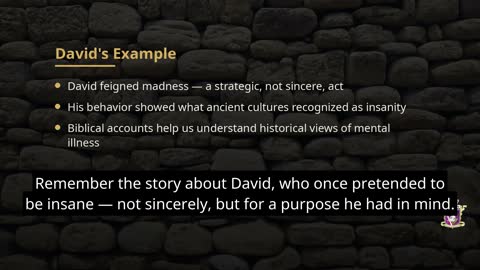
This opening lesson surveys mental disorders, drawing on the DSM-III-R categories, schizophrenia, and cases such as college student Drew and the family of John Hinckley. It weighs biblical accounts of David's feigned madness and Nebuchadnezzar against modern psychiatry, presents Bruce Narramore's four causes of psychopathology, and examines suicide, the history of moral treatment, and how counselors support mentally ill patients and their families.
Lesson 2
Alcoholism takes center stage through Larry's story, introducing the disease-versus-sin debate and E.M. Jellinek's research. You will study genetic predisposition, children of alcoholics, and codependency, along with the family survival roles of enabler, hero, scapegoat, mascot, and lost child. The lesson surveys Scripture on temperance, the intervention technique, detoxification, and support through Alcoholics Anonymous, Al-Anon, and Alateen.
Lesson 3
Building on alcoholism, this session defines addiction broadly, opening with a chaplain addicted to sexual fantasy and eight guiding biblical principles. It compares six explanatory theories, emphasizing peer-cluster theory, and devotes extended attention to eating disorders, obesity, anorexia nervosa, and bulimia, using Raymond Vath's eight patient characteristics and Cherry Boone O'Neill's recovery. Seven steps to recovery and the determination-replacement-need-fulfillment approach close the discussion.
Lesson 4
Money management becomes a counseling concern here, illustrated by Ronnie's mounting band debts and Jackie's failed marriage. The lesson grounds itself in Scripture, the parable of the talents, and the rich young ruler, then diagnoses materialism, greed, impulse buying, and the danger of co-signing. Drawing on Larry Burkett, it teaches distinguishing needs, wants, and desires and building a 10-70-20 budget.
Lesson 5
Vocational counseling is framed through midlife workers like Bobby, Hugh, and Donald and undecided student Carol. Work is presented as God-ordained yet redeemed by Christ, with attention to Holland's six personality-and-job types and the playful square, triangle, circle, and squiggle profiles. You will explore aptitude versus ability, resources like the Dictionary of Occupational Titles, seven vocational stages, and ten questions for evaluating a career.
Lesson 6
Turning inward, this lesson addresses spiritual problems through believers like JC, Ron, and Sue whose faith grew cold. It counters Freud's dismissal of religion, dissects sin, legalism, Gnosticism, asceticism, pride, and bitterness, and cites C.S. Lewis and Richard Foster. Uniquely, it examines the counselor's own dryness, urging Christlike worship, character, and service, prayer, modeling, exhortation, and teaching, with 1 Corinthians 13 on love.
Lesson 7
A wide-ranging session tackles counselor burnout and specialized populations: the physically and mentally handicapped, illustrated by Joni Eareckson Tada, B.F. Skinner, and Jean Vanier's L'Arche communities. It addresses cross-cultural and minority counseling, military families, and prisoners through Chuck Colson's Prison Fellowship and Mike Barber. Extended guidance covers understanding PMS, ministering to persons with AIDS, and helping counselees move from bitterness to forgiveness.
Lesson 8
The closing lesson turns the lens on counseling the counselor, beginning with John's list and the gift of peace of mind. It confronts burnout by teaching counselors to pull back, set priorities and boundaries, and stay accountable, drawing on Henri Nouwen's Genesee Diary, Pat Robertson, and Richard Exley. It urges ongoing study, recommending authors like Dobson, Collins, and Ed Cole, and closes on servanthood.